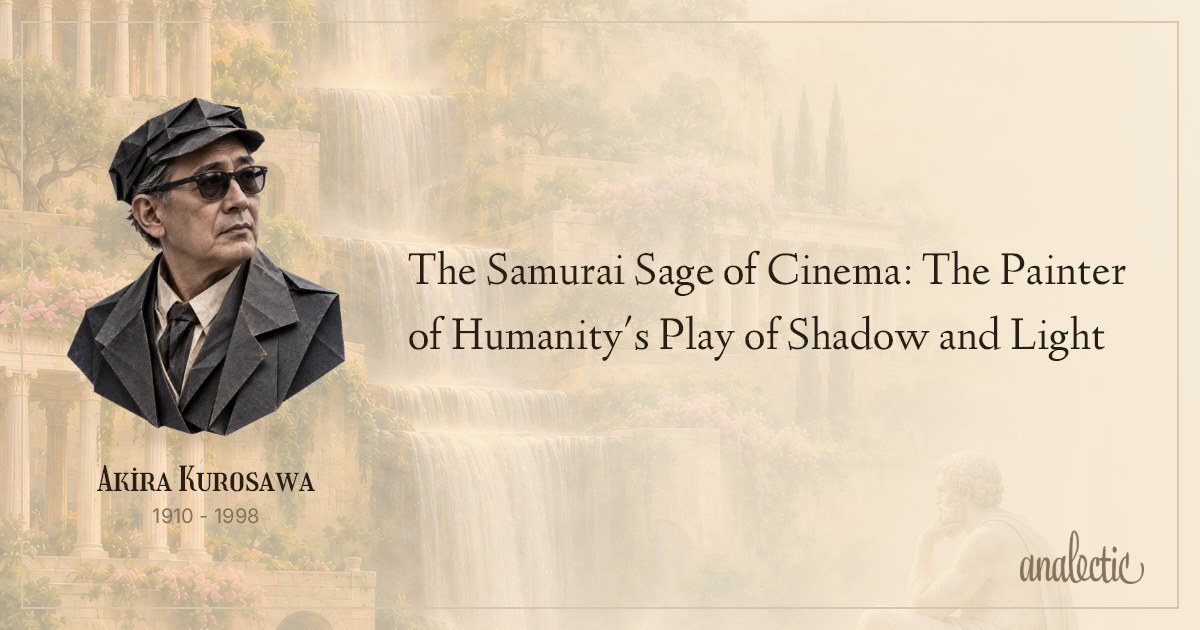
Akira Kurosawa
The Samurai Sage of Cinema: The Painter of Humanity's Play of Shadow and Light (1910 - 1998)
Akira Kurosawa, born in Tokyo in 1910 into a samurai lineage, was raised in a discipline forged by kendo and calligraphy. Though he initially aspired to be a painter, the tragic suicide of his brother Heigo—a silent film narrator—altered the course of his destiny. He entered cinema under the tutelage of director Kajiro Yamamoto, mastering the subtleties of screenwriting and editing; with his 1943 debut, Sanshiro Sugata, he forged a unique language that synthesized traditional Japanese storytelling with Western dramatic structure, beginning to explore the universal foundations where samurai honor clashed with human frailty.His 1950 masterpiece Rashomon, which transformed the human tendency to distort truth through self-interest into an epic metaphor, won the Golden Lion at Venice. This landmark film deepened into themes of collective heroism in Seven Samurai, existential inquiry in Ikiru, and tragic ambition in Ran. Kurosawa composed each frame as if it were a painting, turning rain, wind, and sunlight into sentient characters. Declaring, 'The artist must never relinquish the pursuit of truth,' he rendered the dark and luminous faces of humanity with unwavering honesty.After enduring a creative crisis and suicide attempt in the 1970s, he rediscovered his vision in Dersu Uzala, where he unveiled the paradox of human insignificance and grandeur within Siberia’s boundless wilderness. His creative partnership with Toshiro Mifune gifted cinema with legendary scenes. When awarded the Academy’s Honorary Oscar for Lifetime Achievement in 1990, his humble remark—'There is still so much to learn'—cemented him as a true sage. Kurosawa, who transmuted the contradictions, cruelty, and compassion of the human condition into a visual epic, became both the samurai and the immortal philosopher of cinema.
Akira Kurosawa: quotes
- “To be an artist means never to avert one's eyes from reality, no matter how harsh it may be.”
- “Human beings are unable to be honest with themselves; they cannot talk about their lives without embellishing.”
- “There is nothing that says more about its creator than the work itself.”
- “If you wish to create something monumental, you must be prepared to endure the deepest solitary struggle.”
- “A master craftsman does not rush; every cut, every gesture, and every silence must be entirely deliberate.”
- “In a world consumed by madness, the only sane path is the uncompromising search for moral truth.”
- “When you are creating, you must focus with such relentless intensity that the external world ceases to exist.”
- “It is the courage to confront an empty canvas and look into your own soul that defines true mastery.”
- “True serenity is not the absence of conflict, but the quiet composure preserved at the center of the storm.”
- “Discipline is the sacred forge where raw passion is tempered into enduring art.”
- “To survive the tempest of existence, one must plant one's convictions firmly in the soil of integrity.”
- “The duty of the storyteller is to show humanity what it desperately tries to hide from itself.”
- “Patience is the warrior's highest virtue; observe the shifting currents and wait for the decisive moment.”
- “To accept mortality with quiet grace is the secret to living every remaining day with profound purpose.”
- “In the silence between words and actions resides the unspoken truth of the human heart.”
- “Mastery demands the humility to begin each new day with the pristine curiosity of an apprentice.”
- “The lens does not merely capture physical motion; it registers the invisible weight of the human soul.”
- “Do not crave transient applause; the only worthy judge is your own unyielding conscience.”
- “Focus upon the subtle nuances of reality, for greatness always hides within the smallest gestures.”
- “Even in the bleakest ruin, a single act of selfless compassion possesses the power to redeem human life.”
- “To gaze directly into tragedy and still affirm the sacred beauty of life is the highest form of bravery.”
- “Stillness within oneself is the foundation from which all dynamic creative energy emerges.”
- “Strict artistic discipline does not constrain freedom; it purifies and elevates the creative spirit.”
- “Endure the trials of misunderstanding with silent fortitude; time is the ultimate arbiter of value.”
- “All profound art is ultimately a compassionate prayer for human unity and peace.”
View on Analectic →