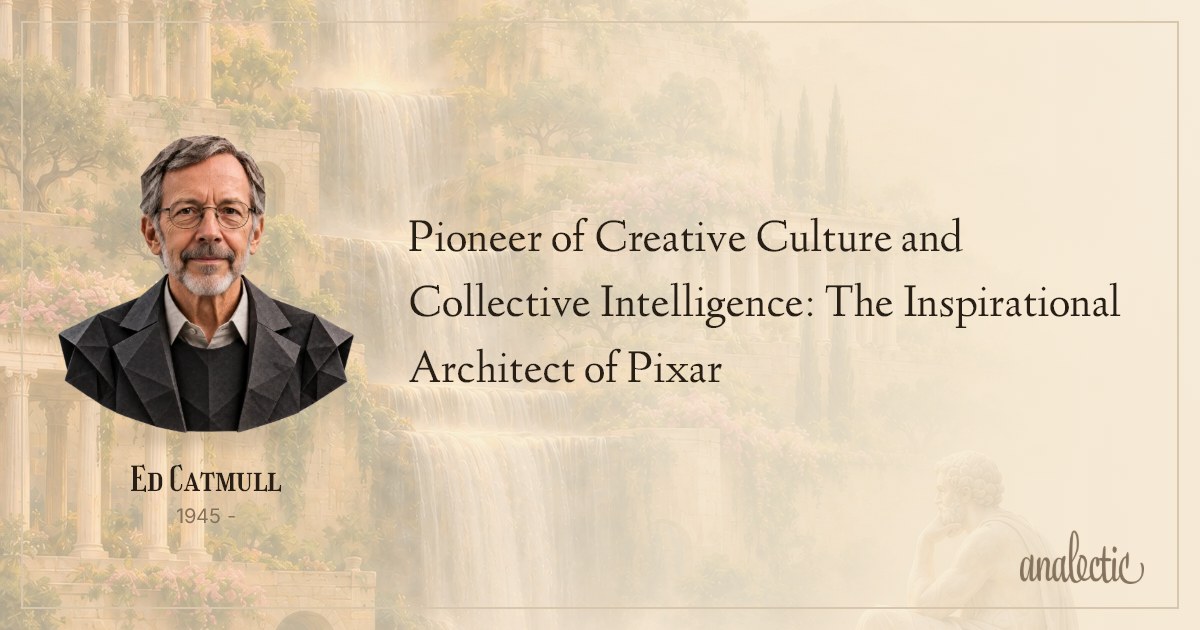
Ed Catmull
Pioneer of Creative Culture and Collective Intelligence: The Inspirational Architect of Pixar (1945 -)
Ed Catmull, born in 1945 in West Virginia, left an indelible mark on the history of digital visualization through groundbreaking doctoral work in computer graphics at the University of Utah. Alongside Steve Jobs and George Lucas, he co-founded Pixar Animation Studios, redefining not only technology but the very belief in imagination. Catmull was among the first leaders to understand that the computer is not merely a tool, but a mirror of art itself. Every film Pixar created was not merely a technical triumph, but the digital embodiment of a human story—and Catmull was its architect.In his seminal work, 'Creativity, Inc.', Catmull did not seek a formula for creativity, but built its culture. Guided by the principle—'Give a great idea to a mediocre team, and they will destroy it; give a mediocre idea to a great team, and they will fix it or make it better'—he elevated team dynamics to their highest potential. Through the 'Braintrust' model, he learned to protect the fragile, flawed, even absurd early forms of films, nurturing them with love and honest feedback. This was no mere studio, but a creative family: every voice mattered, and every mistake was a lesson.Catmull knew that fear kills creativity. He championed the inevitability of failure, even its necessity as a natural ingredient of innovation. Replacing hollow politeness with constructive candor, he elevated truth spoken in trust—because true creativity is born from honest, courageous critique. This visionary leader, who fused technology and art, redefined not only the history of animation but the very meaning of human-centered leadership. His legacy is a philosophy: every project begins as a baby, and every team member must become its parent, tenderly guiding it to life.
Ed Catmull: quotes
- “Creativity is not an idea, it is a process. And this process begins by confronting fears.”
- “An idea, the uglier it appears, the more potential it holds. We must protect them.”
- “Candor is more important than politeness. Politeness hides truth; candor reveals it.”
- “Failure is a consequence of doing something new. Don't hide it—study it.”
- “Good ideas come from good people. People are more important than ideas.”
- “Management is about managing the unseen: fears, silences, hidden conflicts.”
- “Action, no matter how small, changes everything. To act is the ultimate resolve.”
- “A team is not defined by its ideas, but by how it looks at each other.”
- “Discipline frees creativity. Freedom is born within boundaries.”
- “Protecting an idea means letting it evolve—not defending it from change.”
- “Truth is not a polite lie. It is the voice of an uncomfortable fact.”
- “The leader’s job is not to have ideas, but to grow people.”
- “Creativity is not reaching the summit—it is taking the first step on the path.”
- “A project’s success depends not on the plan, but on the depth of trust among the team.”
- “Good feedback is not criticism—it’s a mirror: it reflects, it does not judge.”
- “Stillness is the deepest well of creativity—only in silence do the inner voices speak.”
- “You have to protect the ugly babies — because ugliness is the natural state of something new.”
- “Candor is more valuable than politeness — because honesty drives real progress, not just niceness.”
- “Failure is an inevitable consequence of doing something new — failing is part of succeeding.”
- “People, not ideas, are the source of great work — a great team can turn a bad idea into a great movie.”
- “The success of a project depends not on the system that runs it, but on the people who run the system.”
- “Don’t suppress fear — learn to name it and talk about it, because fear isn’t creativity’s enemy, it’s its companion.”
- “Creativity isn’t an idea — it’s a process, and that process demands regular, disciplined, cumulative effort.”
- “A leader’s job is not to give people ideas — it’s to let them find their own.”
- “If an idea is spoken once and then forgotten, it never becomes real — real ideas are repeated, debated, and shaped.”
- “Management is about managing the unseen — the mood, the trust, and the inner voice of a team.”
- “A team loses its creativity when it loses its inner truth — so we must always confront reality.”
- “Think of yourself not as an idea, but as a process — growth is a way of life, not a fixed destination.”
- “The world moves not just by good ideas, but by people brave enough to talk about them.”
- “No idea, no matter how powerful, is more than a piece of paper without the people who make it real.”
View on Analectic →