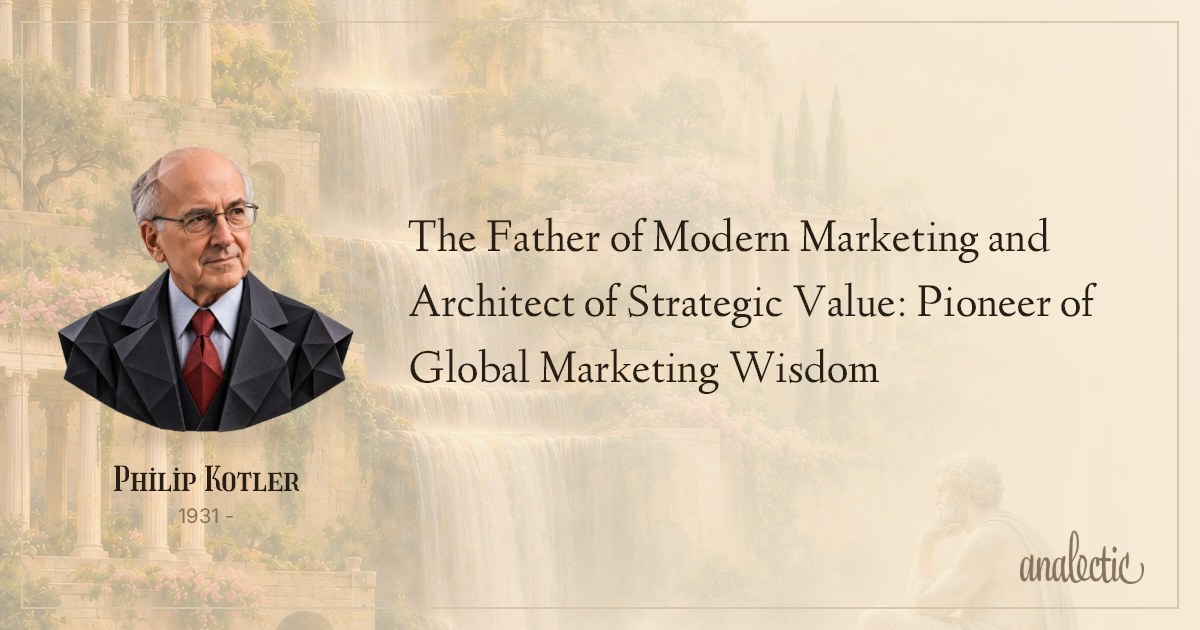
Philip Kotler
The Father of Modern Marketing and Architect of Strategic Value: Pioneer of Global Marketing Wisdom (1931 -)
Philip Kotler, born in Chicago in 1931, was initially shaped by Milton Friedman’s economic thought at the University of Chicago, then deepened his understanding of macroeconomic systems through Paul Samuelson at MIT, where he earned his Ph.D. in economics. Yet it was upon joining the Kellogg School of Management at Northwestern University that he fundamentally overturned the corporate perception of marketing as merely an extension of sales and advertising. He redefined marketing as a science, an art, and a discipline of strategic management—constructing a systematic framework to understand, anticipate, and create value for customers. This transformation marked the first step toward elevating marketing from a corporate profit tool to a social responsibility.Kotler’s seminal work, Marketing Management, published in 1967, has remained the foundational textbook of business schools worldwide for over six decades. Through more than sixty books, he has traced the evolution of marketing across five generations: 1.0, product-centered production; 2.0, consumer-driven demand; 3.0, ethical marketing centered on human spirit and values; 4.0, digital transformation and data-driven engagement; and 5.0, the convergence of artificial intelligence, robotics, and human experience. These classifications are not mere theories but a philosophical roadmap of marketing—a linguistic and intellectual tool to comprehend the paradigm shifts of each era.Kotler’s deepest philosophy: "Marketing is not about finding something to sell; it is the art of creating meaningful solutions that generate value for the customer." This insight embodies a humanistic vision: that corporations must create value not only for shareholders but for society, the environment, and future generations. He embedded sustainability, social justice, and ethical leadership at the very heart of marketing. This thinker, not merely the father of modern marketing but its conscience, revealed that marketing’s greatest power lies in redefining humanity—and this has become the most critical mission of the 21st century.
Philip Kotler: quotes
- “Marketing is about identifying and meeting human and social needs; it is not merely selling a product, but enhancing the quality of life.”
- “A brand’s purpose is not merely to make profit, but to create value for society; this purpose is the key to winning the hearts of customers.”
- “Customer-centricity is not a strategy, but a belief system; every decision must be filtered through the question: 'Does this meet the customer’s true need?'”
- “Market segmentation is not about spraying messages randomly; it is about understanding the deep psychology of each segment and speaking to them in their own language.”
- “Creating value is deeper than price; value is the sum of experience, trust, and a meaningful relationship.”
- “A salesperson is not a negotiator, but a problem-solver; understanding the customer’s problem is more important than solving it.”
- “Marketing is built not by random campaigns, but by consistent discipline—speaking with the same voice at every point of contact.”
- “A great marketing idea is born not from fear, but from courage; to realize it, you must break the existing rules.”
- “Innovation is not merely following technology; it is understanding human emotions and giving them new meaning.”
- “Rejection is a natural part of marketing; every 'no' is a necessary step toward a 'yes.'”
- “A marketing professional must possess inner resilience to rise after failure; this resilience is more valuable than any skill.”
- “People do not buy products; they buy meanings that reflect themselves; the deepest task of marketing is to uncover these meanings.”
- “The true power of marketing is not speaking the customer’s language, but listening to their silent desire.”
- “A brand’s true power lies not in its advertising budget, but in the quality of trust experienced in every customer interaction.”
- “Marketing is not an art, but a science; yet this science becomes meaningless without understanding the human inner world.”
- “A strategy is not merely a planned route; it is a mental discipline that reshapes itself at every moment to meet the customer’s evolving needs.”
- “The greatest mistake in marketing is thinking you know what the customer wants; the real error is failing to understand what they feel.”
- “A leader shapes marketing strategy not just with numbers, but with a story that speaks to the human soul.”
- “Marketing is creating value in the customer's eyes; this value resides not in the product itself, but in the experience the customer has.”
- “A brand’s purpose is not merely to make profit, but to contribute meaningfully to society; a purposeless brand eventually fades away.”
- “Customer-centricity is not a strategy, but a belief system; all decisions must be shaped by the customer’s real needs.”
- “Market segmentation is not random distribution, but conscious selection; knowing which customers to serve is as vital as knowing which to exclude.”
- “A salesperson should not sell a product, but solve a customer’s problem; the one who offers a solution always wins.”
- “Marketing is built not by random ads, but by consistent value delivery; every interaction is a brick in the construction.”
- “Creative boldness is questioning existing rules; a brand must offer not just a better product, but a deeper story.”
- “A campaign must do more than attract attention—it must touch the customer’s inner values; otherwise, it is merely noise.”
- “Rejection is a natural part of marketing; every ‘no’ must be seen as a necessary step toward the next ‘yes’.”
- “A marketing professional must possess inner resilience to rise after failure; this is more valuable than talent.”
- “People decide not based on what they buy, but on how they feel; marketing must speak the language of emotion.”
- “True marketing allows the customer to express themselves; the brand must be their mirror, not their megaphone.”
View on Analectic →