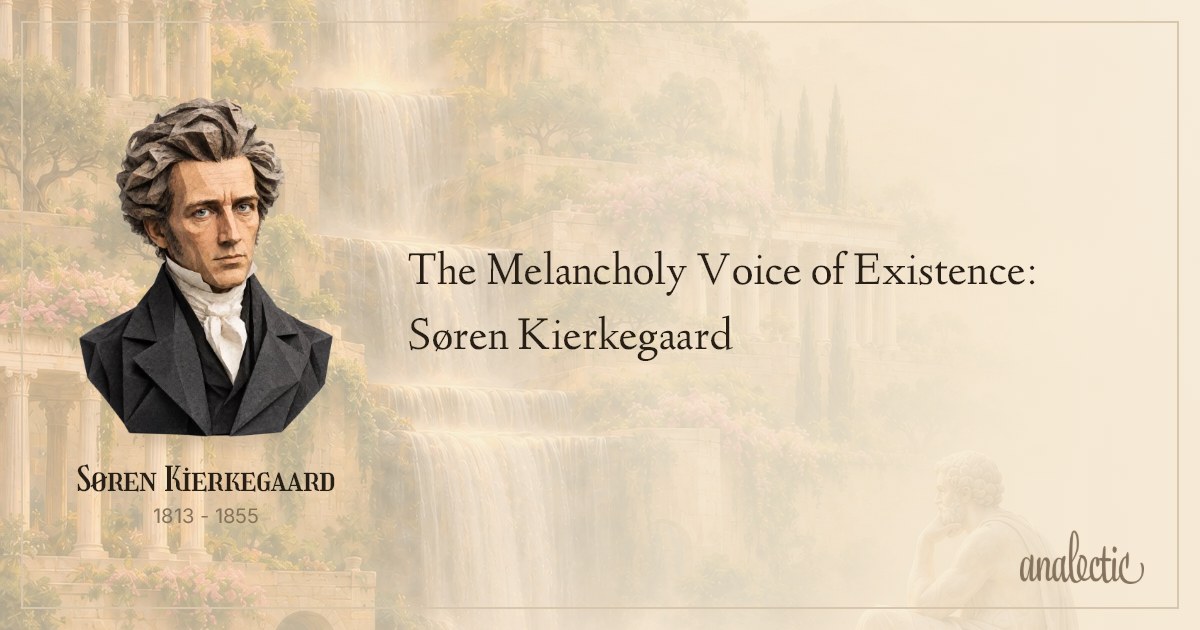
Søren Kierkegaard
The Melancholy Voice of Existence: Søren Kierkegaard (1813 - 1855)
Born in Copenhagen in 1813, Søren Kierkegaard endured a childhood steeped in profound melancholy and religious anxiety as the son of a merchant. The guilt inherited from his father’s Lutheran Pietism and the terror of 'God’s wrath' nurtured existential fissures in his soul from an early age. His rupture with Regine Olsen, to whom he was engaged in 1840, cast under the shadow of a crisis of self-inadequacy, became the most shattering turning point of his life. This tragic renunciation transformed into a symbol of solitude and the torment of choice that would echo through his writings: How does one pay the price of freedom?Revolting against Hegel’s universal systems, he laid the foundations of modern existentialism by asserting that truth arises not from abstract reason but from concrete anguish. Using pseudonyms, he explored the abyss between aesthetic pleasure and ethical responsibility in 'Either/Or', the trial of Abraham’s faith in 'Fear and Trembling', and the vertigo born of freedom in 'The Concept of Anxiety'. With his three stages of existence, he mapped the arduous journey from the mundane to the sacred. For him, authentic existence resided solely within the individual’s inwardness.Kierkegaard, by insisting that truth is subjective rather than objective, opened a radical gateway to twentieth-century thought. While attempting to reconcile reason and passion through the notion of the 'leap of faith', he redefined anxiety as a liberating force. The courage to create meaning despite the absurdity of existence nourished countless philosophical currents—from Heidegger’s analysis of 'anxiety' to Sartre’s critique of 'bad faith' and Camus’s revolt against the 'absurd'. He was not merely a philosopher, but a poet of doubt and hope haunting the modern soul.
Søren Kierkegaard: quotes
- “Life can only be understood backward; but it must be lived forward.”
- “Anxiety is the dizziness of freedom.”
- “To dare is to lose your footing for a moment; not to dare is to lose yourself.”
- “People rarely use the freedom of thought they possess, instead demanding the freedom of speech as its substitute.”
- “The most common and dangerous form of despair is not to will to be oneself.”
- “When you categorize me, you annihilate me.”
- “Prayer does not change God, but it transforms the one who prays.”
- “If you marry, you will regret it; if you do not marry, you will also regret it. If you hang yourself, you will regret it; if you do not hang yourself, you will also regret it. Whether you laugh or weep, you will regret both. This is the sum of all philosophy.”
- “Faith begins precisely where reason ends, where one steps from the shore into the void.”
- “The door of joy does not open outward, but inward.”
- “The deepest truth is subjectivity—the moment the individual confronts his own existence and takes full responsibility for it.”
- “Silence is the most sublime temple that God has created for the soul to hear its own inner voice.”
- “My smile is but a mask concealing the hell within me.”
- “All true transformations occur in silence.”
- “To truly lead a person to a certain place, you must first find them where they are and begin there—otherwise, you are no more than a proud preacher preaching to the wind.”
- “Despair is the sickness unto death, for its torment is precisely the inability to die.”
- “True love is to love without conditions and without demand for return.”
- “The rush of everyday life is the soul's most dangerous anesthetic.”
- “The person who is at war with themselves is defenseless against the whole world.”
- “Iron is forged while it is hot; man, however, matures in the fire of his own existential crises.”
- “To refuse to choose is itself a choice.”
- “To conform to the crowd is easy; to stand alone, however, requires a spiritual greatness.”
- “Suffering is the awakening of consciousness.”
- “Irony is the mind's defense against the world's absurdities.”
- “Anxiety over the future steals the strength of the present.”
- “Each person's task is to become the very self they are destined to be.”
- “Love is an act of free will, crowned by devotion.”
- “Whoever listens to eternity will not be lost in time.”
- “The shortest path to a person's heart is through reverence for their suffering.”
- “The leap of faith is to cast oneself into the vast ocean of the infinite, leaving behind the safe harbor of reason.”
View on Analectic →